

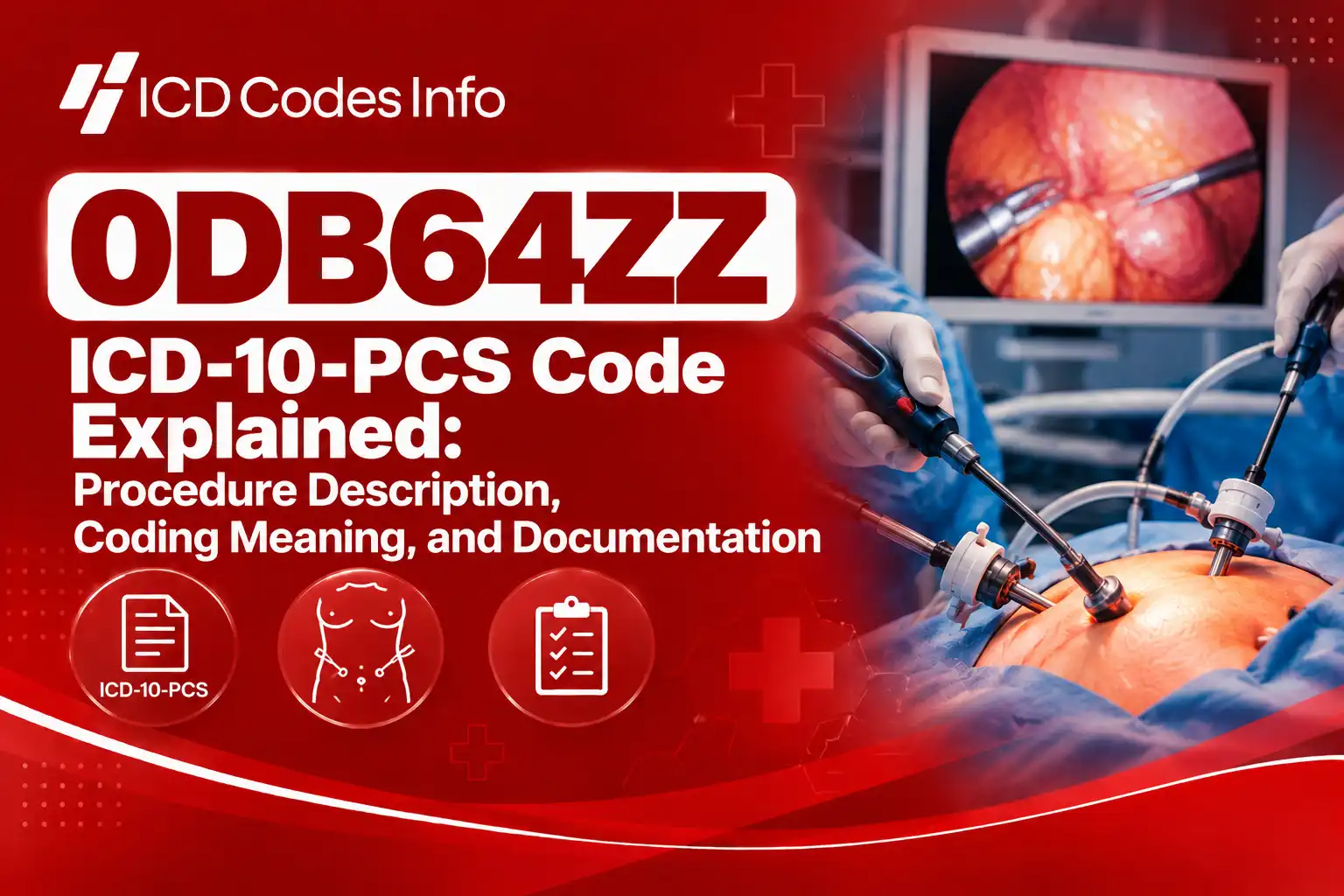
0DB64ZZ is an ICD-10-PCS code for Excision of Stomach, Percutaneous Endoscopic Approach. This procedure falls under the Medical and Surgical Section and the Gastrointestinal System Body System Category. Excision is identified as the root operation with the stomach listed as the body part. CMS codes 0DB64ZZ among other codes in its FY2026 ICD-10-PCS codes.
It is necessary to note that care should be exercised in coding 0DB64ZZ since various gastric procedures have similar terminologies. The presence of a laparoscopic approach in gastric surgery does not mean it is coded as 0DB64ZZ. The coder has to establish which part of the stomach was excised, which root operation to use and the approach of the procedure. The difference between Excision and Resection is very crucial in coding the procedure. According to ICD-10-PCS, excision is defined as the excision out or away from a portion of a body part without replacing the same.
What Does 0DB64ZZ Describe?
According to the official description of 0DB64ZZ, it is an Excision of Stomach, Percutaneous Endoscopic Approach. The third character is B for Excision. The fourth character is 6, which represents the stomach. Percutaneous endoscopic approach 5 is represented by the 5th character.
The code is concluded with ZZ. No Device is represented by the 6th character and No Qualifier is represented by the 7th character. These seven characters are all that can be said about the PCS procedure. The code should only be made when all the necessary components are documented. If the approach, extent of removal, or purpose is different, another PCS code might be better.
How Is 0DB64ZZ Structured?
ICD-10-PCS uses a 7 character coding system for inpatient procedures. Every character gives one part to make the final code. CMS coding examples show coders how they are using the PCS table to pick the individual characters rather than relying solely on a procedure title to designate a code.
| Character | Value | Meaning |
|---|---|---|
| 1 | 0 | Medical and Surgical |
| 2 | D | Gastrointestinal System |
| 3 | B | Excision |
| 4 | 6 | Stomach |
| 5 | 4 | Percutaneous Endoscopic |
| 6 | Z | No Device |
| 7 | Z | No Qualifier |
The first character designates the ICD-10-PCS’s overall section. The second character is for the Gastrointestinal System. The third character indicates the root operation, this is Excision. The fourth character establishes the stomach as the body part. The fifth character identifies the percutaneous endoscopic approach. The final characters establish the device and qualifier values.
What Does Excision Mean in ICD-10-PCS?
Excision is the removal of some part of a body without replacement. The term ‘portion’ is significant since the root operation does not refer to the complete removal of the defined body part. There is a distinction between Excision and Resection in the coding guidance provided by the Centers for Medicare and Medicaid Services (CMS).
The body part of 0DB64ZZ is the stomach. Thus the code is not for the complete stomach removal but rather for removal of a part of the stomach. This distinction affects code selection. A coder should review the operative documentation carefully when terms such as partial, subtotal, sleeve, wedge, or gastrectomy appear. The documented anatomical extent should guide the root operation.
Excision Versus Resection
Excision and Resection are two different ICD-10-PCS root operations. Excision removes a portion of a body part. Resection removes all of a defined body part. CMS coding guidance directs coders to use the more specific root operation when the procedure meets its definition.
This distinction is important because the stomach has a specific body part value. A procedure removing all of the stomach should not be coded as Excision of Stomach merely because the operative note uses the general word “removal.”
| Root operation | Basic meaning | Coding focus |
|---|---|---|
| Excision | Portion removed | Part of the defined body part |
| Resection | Entire defined body part removed | All of the defined body part |
The coder should base the decision on the procedure actually performed. Clinical terminology should be reviewed in the context of the full operative report.
What Does the Stomach Body Part Represent?
The fourth character of 0DB64ZZ is 6, which identifies the stomach. This body part value distinguishes the procedure from excision of other gastrointestinal structures.
The gastrointestinal system includes the structures of the esophagus, stomach, small intestine, duodenum, jejunum, ileum and large intestine, each of which has a value for the body parts. These body part differences are reflected in the appropriate PCS tables in CMS materials.
Therefore, the coder should not select the stomach value simply because the procedure occurred in the upper abdomen. The operative report should clearly support treatment of the stomach.
Why Does the Approach Matter?
The fifth character of 0DB64ZZ is 4, representing the percutaneous endoscopic approach. This approach is used when the procedure is performed through a percutaneous access route with endoscopic visualization or instrumentation. The approach is a required part of the PCS code. It is not an optional detail. A procedure involving the same root operation and body part may produce a different code when the approach changes.
CMS guidance also explains that an open approach with percutaneous endoscopic assistance is coded to Open. Therefore, the coder must determine the actual access method instead of assuming that any procedure described as laparoscopic receives the percutaneous endoscopic character.
When Is 0DB64ZZ Appropriate?
0DB64ZZ is appropriate when the documentation supports excision of a portion of the stomach through a percutaneous endoscopic approach. The procedure must meet the definition of Excision rather than Resection or another root operation.
The operative report should establish that gastric tissue was removed. It should also support the approach used to access the stomach. If the procedure involved a diagnostic biopsy, the coder should evaluate whether the Diagnostic qualifier is required instead. The final assignment should come from the applicable PCS table. The coder should not select the code based only on the surgical procedure name.
How Does a Gastric Biopsy Change Coding?
A gastric biopsy requires additional attention to the PCS qualifier. CMS coding guidance identifies biopsy procedures performed using Excision with the Diagnostic qualifier. This changes the seventh character from the No Qualifier value used in 0DB64ZZ.
For example, 0DB64ZX represents Excision of Stomach, Percutaneous Endoscopic Approach, Diagnostic. CMS lists both 0DB64ZZ and 0DB64ZX in the applicable code set. This distinction means that coders should review the purpose of the tissue removal. A procedure performed to obtain tissue for diagnostic examination requires different consideration from a therapeutic excision.
What Does the No Device Character Mean?
The sixth character of 0DB64ZZ is Z, meaning No Device. This does not mean that no surgical instruments were used during the operation. It refers to the ICD-10-PCS device character and whether a qualifying device remains after the procedure.
Routine instruments used during surgery are not automatically reported as PCS devices. The coder should evaluate whether a device meeting PCS requirements remains in the body after the procedure. This distinction prevents normal surgical equipment from being incorrectly treated as a coded device. The final device character should therefore be based on PCS definitions and documentation.
What Does the No Qualifier Character Mean?
The seventh character of 0DB64ZZ is Z, meaning No Qualifier. A qualifier provides additional information about a procedure when the applicable PCS table includes a qualifying value.
The Diagnostic qualifier is an important example for gastric excision. A diagnostic excision can produce a different code because the purpose of the procedure is reflected in the final character. CMS coding guidance specifically addresses the use of the Diagnostic qualifier for biopsy procedures.
Therefore, the coder should not assume that all gastric excisions end with ZZ. The final character must match the procedure documented in the medical record.
What Documentation Supports 0DB64ZZ?
All operatives should be documented in full in the code. The record should provide a clear description of removal of the item, where it was removed, and how the surgeon gained access to the stomach.
Review these documentation elements:
- Stomach identified as the treated body part
- Portion of stomach removed
- Excision documented as the operative objective
- Percutaneous endoscopic access documented
- Reason for tissue removal
- Anatomical location of the excised portion
- Operative findings
- Procedure completed without conversion when applicable
- Diagnostic purpose documented when applicable
- Devices remaining after the procedure
- Other procedures performed during the same operation
The operative report should provide enough information for the coder to determine the root operation independently. If essential details are missing, a compliant provider query may be necessary.
How Does the Operative Objective Matter?
The operative objective helps distinguish Excision from other root operations. The coder should determine why the procedure was performed and what the surgeon intended to accomplish. For example, removal of a portion of gastric tissue may support Excision. Drainage of fluid from the stomach would involve a different root operation. Inspection without tissue removal would also require a different code. The same anatomical location can therefore produce different PCS codes. The body part alone does not determine the final procedure code.
What If the Procedure Converts to Open?
A conversion from a percutaneous endoscopic procedure to an open procedure requires careful review of the completed operation. CMS guidance states that procedures performed using an open approach with percutaneous endoscopic assistance are coded to the Open approach.
The coder should therefore review the operative report to determine how the completed procedure was performed. If the final excision was completed through an open approach, the applicable Open approach code should be considered instead of automatically retaining the percutaneous endoscopic approach. The documented procedural sequence is important. The code should represent the approach used for the completed procedure.
Several codes involve excision of the stomach but use different approaches or qualifiers. These distinctions should be reviewed before final code selection.
| Code | Procedure description |
|---|---|
| 0DB60ZZ | Excision of Stomach, Open Approach |
| 0DB63ZZ | Excision of Stomach, Percutaneous Approach |
| 0DB64ZZ | Excision of Stomach, Percutaneous Endoscopic Approach |
| 0DB64ZX | Excision of Stomach, Percutaneous Endoscopic Approach, Diagnostic |
| 0DB64Z3 | Excision of Stomach, Percutaneous Endoscopic Approach, Vertical |
CMS lists these related gastric excision codes in its current FY2026 materials.
The differences are significant. The third character remains Excision, while the fifth character changes when the approach changes. The seventh character changes when the qualifier changes.
How Is 0DB64ZZ Different From Gastric Resection?
A gastric resection uses the Resection root operation when the entire defined stomach body part is removed. Excision applies when only a portion of the defined body part is removed. CMS defines Resection as cutting out or off all of a body part without replacement.
This distinction should be evaluated from the operative documentation. The coder should determine the anatomical extent of removal rather than relying only on common clinical terminology. A procedure may use terminology that does not directly match the PCS root operation. That is why the PCS Index, tables, definitions, and operative report should be considered together.
What Are Common Coding Errors?
One common error is assigning 0DB64ZZ to every laparoscopic stomach procedure. The use of laparoscopic equipment establishes an access method but does not independently establish Excision as the root operation. Another error is confusing partial removal with complete removal. Excision and Resection have different definitions in ICD-10-PCS. CMS guidance requires the appropriate root operation based on the actual anatomical extent of the procedure.
A third error is missing the Diagnostic qualifier. A biopsy performed through a percutaneous endoscopic approach may require a different seventh character. CMS specifically identifies Diagnostic as the qualifier for biopsy procedures using Excision. Coders may also select the wrong approach when a procedure begins endoscopically but is completed through an open approach. The complete operative sequence should be reviewed before final assignment.
How Can Coding Teams Review Gastric Procedures?
A structured review can help reduce errors with gastric PCS codes. Start by identifying the procedure’s actual objective. Then determine whether the documented removal involves a portion or the entire defined body part. Then check the anatomical site. Establish that it was the stomach and not another gastrointestinal structure. Then check the approach and see if it was done percutaneously, percutaneously endoscopically or open. Finally, review the device and qualifier characters. The coder should specifically check for diagnostic biopsy documentation and any applicable device information before finalizing the seven-character code.
Does 0DB64ZZ Affect MS-DRG Assignment?
CMS FY2026 MS-DRG materials include 0DB64ZZ among procedures used in the MS-DRG classification system. The code appears with gastric procedure groupings and may contribute to different classifications depending on the complete inpatient record.
The final MS-DRG cannot be decided based on 0DB64ZZ. The grouping is composed of all the following, principal diagnosis, secondary diagnoses, complications, comorbidities, and procedures. This makes accurate procedure coding important for inpatient classification. However, a coder should not use the procedure code alone to predict or assign the final DRG.
How Does Documentation Support Revenue Integrity?
Procedure documentation affects more than code selection. It provides the evidence needed to support the coded service during internal review, payer review, and coding validation. For gastric procedures, unclear documentation can create uncertainty about the extent of tissue removal. It can also make the approach or diagnostic purpose difficult to establish. These gaps can lead to coding clarification requests or inconsistent code assignment. A consistent documentation review process helps coding teams identify missing information before final billing. It also gives clinical teams clearer feedback about the details needed for accurate PCS assignment.
0DB64ZZ Coding Checklist
Before finalizing 0DB64ZZ, confirm each element below:
- Confirm the procedure was performed during an inpatient encounter.
- Confirm the stomach is the documented body part.
- Determine whether only part of the stomach was removed.
- Verify Excision as the root operation.
- Confirm the percutaneous endoscopic approach.
- Review whether the procedure was diagnostic.
- Check whether a Diagnostic qualifier applies.
- Confirm the device character.
- Review any other procedures performed during the encounter.
- Check for conversion to an open approach.
- Confirm the final seven-character code in the applicable PCS table.
- Verify the correct fiscal-year code set for the discharge date.
Final Takeaway
0DB64ZZ is a Percutaneous Endoscopic Approach to the Excision of Stomach ICD-10-PCS code. The code represents the Medical and Surgical section, the Gastrointestinal System, the Excision root operation, the Stomach, the percutaneous endoscopic approach, No Device and No Qualifier.
The most critical coding choice is between Excision vs Resection. Excision involves removing part of the defined body part, Resection involves removing the entire body part. CMS also offers some guidance on diagnostic biopsies, approaches, and procedures assisted by endoscopy.
Accurate assignment depends on the operative documentation. Coding teams should verify the anatomical extent, procedural objective, approach, diagnostic purpose, device status, qualifier, and applicable fiscal-year code set before finalizing the inpatient procedure code.
