

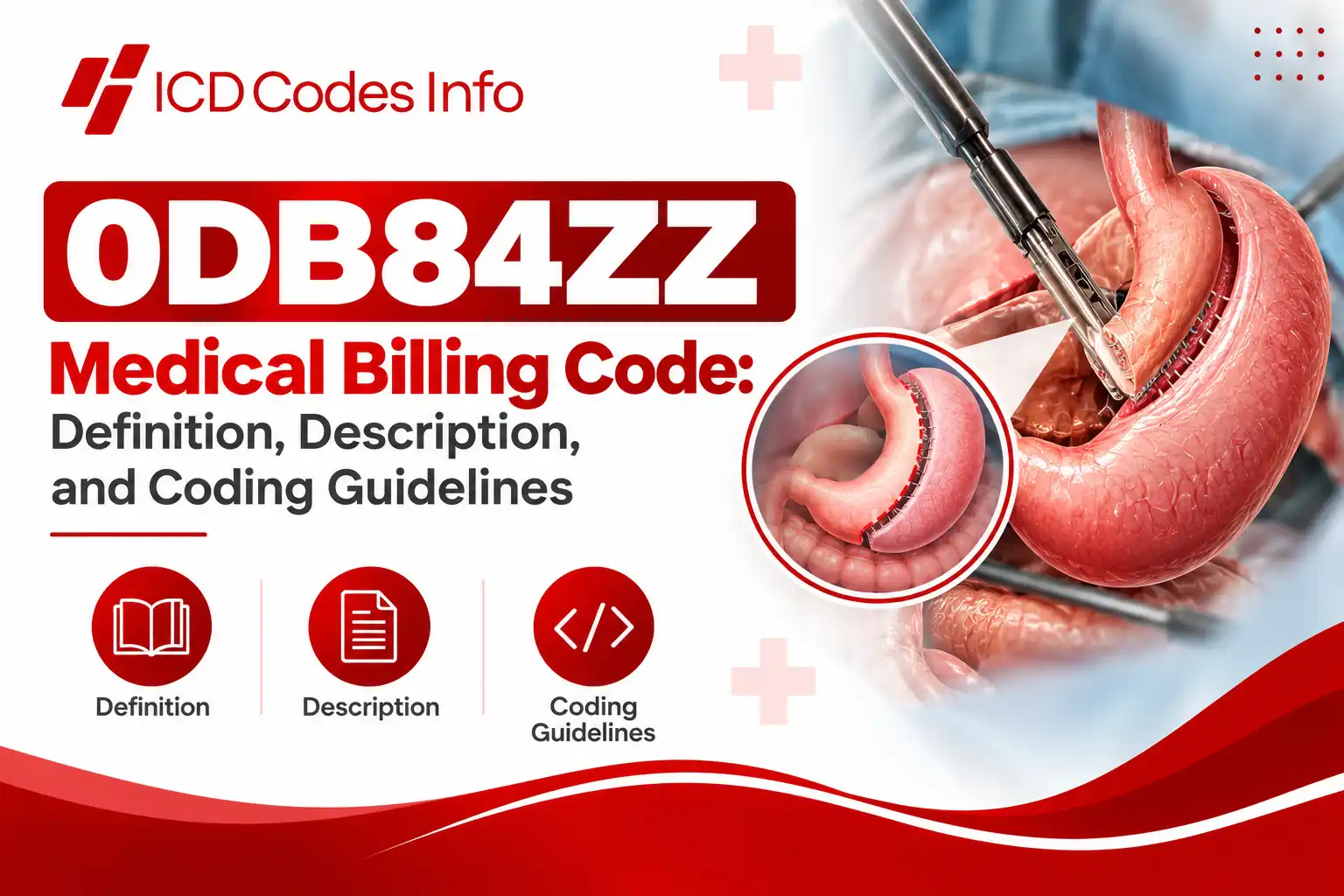
This is the Healthcare Common Formats coding for 0DB84ZZ is Excision of Small Intestine, percutaneous endoscopic. ICD-10-PCS codes are used to capture procedures carried out to the patient while he or she is an inpatient in the hospital. Particularly important codes for accurate coding include Operative Report, Body Part and Surgical Approach.
Whether you are a revenue cycle management professional, medical coder, or billing specialist, this understanding of 0DB84ZZ will help you to accurately code inpatient procedures. This can lead to claim edits, wrong claims being coded or reimbursement issues if the wrong claims are being coded. This guide provides an explanation of the content of the code, its structure, what should be included in a comment (and what shouldn’t!), and a few ideas on coding.
Quick Answer: What Is the 0DB84ZZ Medical Billing Code?
The ICD-10-PCS procedure code 0DB84ZZ means “Excision of Small Intestine, Percutaneous Endoscopic Approach”. It refers to a process whereby a piece of the small intestine is removed via a ‘percutaneous (transperineal) approach’.
ICD-10-PCS is also referred to as the International Classification of Diseases-Tenth Revision (Procedure Coding System). It is mainly the inpatient hospital environment of the United States where it is used to report procedures. Unlike ICD-10-CM, which categorizes diagnoses, it is not a classification system of procedures as is used in CPT, which is often used to report professional and outpatient procedures.
The important features of the code are:
- Medical/Surgical section.
- The gastrointestinal system is one of the body systems.
- Excision root operation.
- Small bowel part of the bowel.
- Percutaneous Endoscopic approach.
- No Device value.
- No Qualifier value.
Coding should always be done to a claim by referring to the official ICD-10-PCS tables for the current Fiscal year.
What Is the Official Description of ICD-10-PCS Code 0DB84ZZ?
According to the official description 0DB84ZZ is “Excision of Small Intestine, Percutaneous Endoscopic Approach.”
This description conveys different parts of the procedure verb.
Excision
Excise: Cut out or off, but not replace, the body part. The documented procedure has to allow for the removal of a segment of small intestine; this is not required to be the entire length of the small bowel.
Small Intestine
Body-part values indicate that the structure affected is the small intestine. This body-part selection shall be backed up with the operative report.
Percutaneous Endoscopic Approach
It is a technique that requires traversing and visualizing the operative field through a defined hole or small incision which is presented by a special instrument inserted into the body. The method used should be the same as the method used by the surgeon, and consistent with the ICD-10-PCS definition.
Using the procedure description doesn’t constitute code assignment. The coders are responsible for reading through the entire operative report and using the appropriate coding rules.
How to Break Down the Seven Characters of 0DB84ZZ
ICD-10-PCS is a seven character code set, representing an inpatient procedure. They represent particular classification elements with each character. These characters are combined to designate a section, body system, root operation, body part, approach, device or qualifier.
| Character | Value | Meaning |
|---|---|---|
| First | 0 | Medical and Surgical |
| Second | D | Gastrointestinal System |
| Third | B | Excision |
| Fourth | 8 | Small Intestine |
| Fifth | 4 | Percutaneous Endoscopic |
| Sixth | Z | No Device |
| Seventh | Z | No Qualifier |
The first character designates the procedure to the Medical and Surgical section. The second one is for identification of the gastrointestinal system. The third states the root operation is excision.
The fourth one refers to the small intestine. The fifth one is for percutaneous endoscopic access. The last two characters are for “no device” and “no qualifier”.
All of the characters in these codes must be matched with the corresponding ICD-10-PCS table. Even a description that sounds suitable doesn’t qualify as a code until supported with the medical record.
What Does Excision of the Small Intestine Mean?
Excision is the removal of an area of a body part with no replacement. ICD-10-PCS has divided this definition from other root operations.
A small intestine is a portion of the gastrointestinal tract. It includes the small bowel (duodenum, jejunum, ileum). On the other hand, the value “0DB84ZZ” refers to the small intestine as a single unit, rather than to the jejunum or the ileum as distinct units.
Understanding the Excision Root Operation
What the Surgeon performed on the Body Part. For 0DB84ZZ, it is necessary to back up with the relevant documentation that removing a segment of the small bowel without replacement is an acceptable procedure.
Occasionally, surgeries refer to “removal” or “resection” and these should not be judged as an indicator for assigning excision. They should apply the procedure in line with ICD-10-PCS procedure definition and the operative details.
For instance, if a small part of the intestine is trimmed off, it could be helpful for someone to get rid of that section where applicable so as to help with excision. Taking out an entire body part points towards a different root operation.
Identifying the Small Intestine as the Body Part
The surgeon must fill out an operative note that he/she touched a bowel structure. During the procedure the coders are reminded to read the description of the procedure and some anatomy information before they input the Body-part value in the procedure.
If there is a specific code for a particular body part then it must be determined from the writing whether such a code is available by the coder. The use of the broader small intestine value might not be able to replace an appropriate code with documentation and the PCS table.
When Is the 0DB84ZZ Procedure Code Used?
Where this documented procedure contains all of the elements in the official descriptor, the Code 0DB84ZZ is applicable. These include the excision root operation, the small intestine body-part value and the percutaneous endoscopic approach.
The code applies to inpatient hospital procedures. It is not an all purpose code for all small intestine surgeries nor all minimally invasive surgeries of the intestine.
It is vital for coders to check before assigning the 0DB84ZZ:
- The surgery was undertaken on the small intestine.
- The surgeon amputated part of the body part without replacement.
- The technique documented fits the definition of the percutaneous endoscopic approach.
- The selected characters are applicable to the selected ICD-10-PCS table.
- The code is a valid discharge date code and fiscal year code.
Incorrect code: A procedure name is not a correct code. The approach and Root Operation entail in the operative report must be supported.
ICD-10-PCS Coding Guidelines for 0DB84ZZ
There are more steps to the process of proper code assignment than finding a code that matches a procedure description. The coders are required to follow the official coding guidelines and ensure full coding based on the relevant PCS tables.
Confirm the Root Operation
Ensure the procedure complies with the ICD-10-PCS definition for excision. This documentation shall follow up the removal of a small part of the bowel without replacement.
If the procedure, on the other hand, involves the removal of all a specific body part, the root operation might be resection. If the material is removed but not a part of the body part, then another root operation may apply.
Verify the Procedure Approach
The fifth digit, 4, stands for percutaneous endoscopic. The method is to gain access into a point of entry site through a hole or small incision then accessing and viewing the procedure area with instrumentation.
Even when the surgeon says that the surgery is “minimally invasive,” do not take that choice. Discuss access and visualization of the operative field by the surgeon. The process that is documented needs to meet the official approach definition.
Review Device and Qualifier Values
The sixth character (Z) represents a device which does not apply to the procedure. If a character is followed by the letter Z, then no qualifiers follow.
The relative values should correspond with the values given in the tables corresponding to the PCS. They are not advisers to the surgeon on all removals of a portion of the intestine. The entire program should demonstrate rules of classification and procedure followed.
Follow the Official ICD-10-PCS Tables
Using the Alphabetic Index, find the code in the corresponding alphabetical table. If the Official Guidelines for Coding and Reporting need to be consulted for additional interpretation of a coding question, consult these rules.
Every fiscal year CMS issues new guidelines and ICD-10-PCS coding. Therefore, discharges dated October 1st, 2027 or thereafter will need files specific to FY 2027 and updates to account for any significant changes.
What Documentation Supports 0DB84ZZ Coding?
Full documentation enables the coder to choose a code that is true to the procedure. The purpose of the operative report is particularly important since it outlines the surgical goal(s), anatomic structures to be accessed, and surgical approach.
Complete documentation is helpful for coders in selecting the appropriate code to define an acceptable procedure. The operative report is especially important due to the fact that it indicates the surgical objective, anatomy and approach.
Please look at these elements of documentation:
- Issues the surgeon intends to perform, with the objective expressed.
- Structure involved and part of the small intestine affected.
- The amount of tissue excised.
- Procedures and methods carried out during the operation
- Important information relating to devices or to other procedures.
- Some resolution of incomplete and conflicting documentation.
When the report doesn’t specify whether the procedure was considered excitation or not, the coder should consult the provider to determine this, as appropriate, while reviewing the entire record.
Each code character should be backed up by documentation. Never assume procedural information from the patient’s diagnosis, a scheduled surgical procedure or a short procedure name.
There are a few ICD-10-PCS codes that categorize the small intestine’s removal procedure in other methods. The one which is decided depends on the documented procedure as well as the relevant PCS table.
| ICD-10-PCS code | Official description |
|---|---|
| 0DB80ZZ | Excision of Small Intestine, Open Approach |
| 0DB83ZZ | Excision of Small Intestine, Percutaneous Approach |
| 0DB84ZZ | Excision of Small Intestine, Percutaneous Endoscopic Approach |
| 0DB87ZZ | Excision of Small Intestine, Via Natural or Artificial Opening |
| 0DB88ZZ | Excision of Small Intestine, Via Natural or Artificial Opening Endoscopic |
These codes differ mainly as it relates to the method for accessing the site of operation. It is important for coders to choose the approach that is the most appropriate to the actual procedure and not rely on the assumption that all minimally invasive treatments have the same code.
Excision vs. Resection
The following is a description of two separate root operations in ICD-10-PCS: Excision and resection.
Excision is the process of cutting out or off a body part that doesn’t replace it. The term resection involves excision or separation of a part of the body, without restoration.
In the case of 0DT84ZZ, it means the small intestine was resected in a percutaneous-endoscopic manner. It is different from 0DB84ZZ, since there is a substitution of the root operation from excision to resection.
The root operation selected shall be supported in the operative report. The selection of either excision or resection should not be made on the basis of the words used in the procedure title alone by coders.
How Does 0DB84ZZ Affect Medical Billing and Reimbursement?
Accurate ICD-10-PCS coding is essential to inpatient hospital billing for giving the provider a hospital report of the services the hospital provided. The Inpatient Claim Processing Clinical and Procedural Information provided by the code.
Impact on Inpatient Claims
Applicable ICD-10-PCS procedure codes are reported on inpatient facility claims by the hospital. Claim edits, inaccurate reporting or further review may occur due to coding errors. Correct coding prevents information on the medical record from being in conflict with the claim.
Relationship Between Procedure Coding and MS-DRGs
ICD-10-PCS procedure codes can be used where applicable in Medicare Severity Diagnosis Related Groups (MS-DRG). But that isn’t the only code that dictates the final DRG or reimbursements.
Final results are affected by the patient’s main diagnosis, any other diagnoses, qualifying procedures, discharge circumstances and grouping rules. Reimbursement will also vary with the payer and the payment methodology.
Why Accurate Documentation Matters
The inability to fully document makes it more difficult to identify the appropriate approach, body part, and root operation. The Coding Teams should address gaps in available material documentation prior to finalization of the claim.
Proper coding helps to ensure proper reimbursement review. Does not guarantee payment and isn’t a partial protection against all claims being denied.
Common Coding Errors to Avoid With 0DB84ZZ
Also, errors are frequently caused by the coders not reading the operative report and official coding rules.
Be alert to the following types of issues:
- Mixing up the terms resection and excision.
- Choosing percutaneous endoscopic procedure without a documented technique.
- If a more specific value does apply, using the broad small intestine body part value.
- Setting the code without examining the current PCS table.
- Interpretation of ICD-10-PCS as diagnosis code or using CPT procedure code.
- This assumes that 0DB84ZZ is for all laparoscopic small bowel surgeries.
- Entering an incorrect code set for discharge date.
- Interpreting the use of an HPEP as a promise to pay.
Avoid such errors with a careful reading of the operative report and the use of valid characters and the current official coding guidelines.
Best Practices for Accurate 0DB84ZZ Coding
There needs to be a common verification process for intestinal procedures in medical coding and billing teams.
In the case where the operative report is available, review the report. Learn the purpose, location, type of tissue removed and type of surgery to be performed.
If there is no choice but to proceed with the root operation, think carefully before doing so – it is a critical move. Discover if the document is favoring an excision or another procedure as the “root operation.
Check the body part value. Ensure that the small intestine (or other anatomical value) matches the documented procedure.
Validate the approach. Verify technique adheres to ICD-10-PCS definition of percutaneous endoscopic.
Look up the official PCS table. Check all seven characters and check the validity of the code for the correct/fiscal year.
Resolve documentation gaps. Ask for clarifications from providers if necessary steps do not clarify.
Check the claim prior to submission. Match financial requirements and medical record with reported procedure.
These steps foster consistency in coding teams, avoid unnecessary mistakes, and aid in accurate inpatient procedure reporting.
Conclusion
0DB84ZZ is an unassigned code in the Bill & Code set, which is assigned to the procedure of Excision of small intestine, through percutaneous endoscopic approach. It has seven characters that tell you information about the medical/surgical section, gastrointestinal system, the root operation excision, an approach to the small intestine, the device and the qualifier.
The operative report is an important part of the assignment process; the root operations chosen must be appropriate and confirmed with corresponding tables from ICD-10-PCS. Medical coding and billing staff should adhere to the latest official guidance and have a look at the whole inpatient claim submission before sending it out.
Here’s how having uniform coding helps healthcare organizations.
